what are the parts of a water pump?
2026-03-09
Table of content
Water pumps are essential in homes, farms, and industries. They move water from wells, supply buildings, drain flooded areas, and maintain plumbing pressure. Most people use pumps daily without realizing the many components working together to ensure smooth operation. Each part—large or small—supports continuous water flow and prevents breakdowns.
A water pump converts energy into pressure, pushing water from one place to another. Understanding its components helps with troubleshooting, maintenance, and selecting the right pump. Whether you are a technician, homeowner, farmer, or car owner, knowing the parts of a pump saves time, effort, and repair costs.
From the impeller to the motor, this guide explains the major components of a water pump in simple terms, focusing on centrifugal pumps while briefly mentioning other common types. BISON, a professional water pump manufacturer in China, provides this clear overview to help you maintain and troubleshoot your pump effectively.
Note: This guide focuses on centrifugal and engine-driven water pumps commonly used in industrial, agricultural, and residential settings. If you are looking for automotive cooling system water pumps, this article does not cover those. The components described here apply to standalone water pump units, including both gasoline-powered and diesel-powered models.
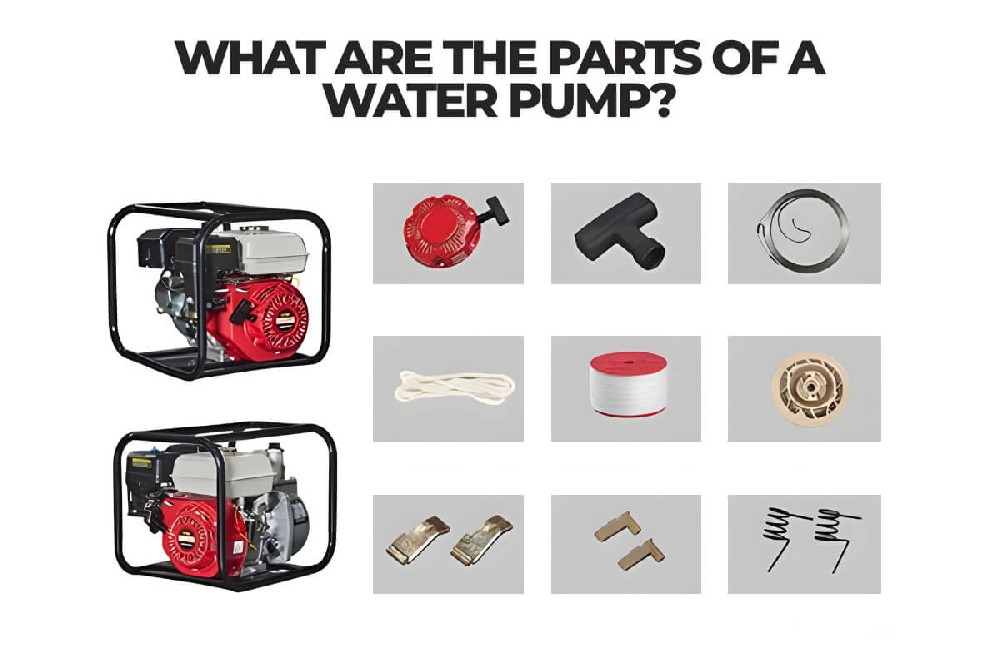
Key components of a water pump
Every water pump, large or small, relies on essential internal components to generate pressure, move water efficiently, prevent leaks, and maintain stability during operation. Understanding these parts helps with maintenance, troubleshooting, and proper pump selection. Below are the main components found in most centrifugal and domestic water pumps.
Pump casing
The pump casing is the sturdy outer housing that contains the impeller, directs water flow, and maintains pressure. It also protects internal components from dust, chemicals, contaminated water, and impacts. A well-designed casing improves efficiency and reduces energy losses.
Types of casings
Volute casing: features a spiral-shaped passage that gradually expands, reducing water velocity and converting it into pressure. It minimizes turbulence and ensures consistent water delivery, making it ideal for centrifugal pumps.
Diffuser casing: includes stationary vanes around the impeller that guide water in a controlled manner. This design slows water efficiently, increases pressure, and reduces hydraulic losses. Diffuser casings are commonly used in multistage pumps.
Impeller
The impeller is the heart of the pump, rotating at high speed to push water outward using centrifugal force. Its design, size, and number of vanes determine the pump's flow rate and pressure.
Types of impellers
Open impeller: vanes are exposed on both sides. Can handle water with sand, mud, or debris, making it ideal for construction, agriculture, and drainage. Slightly less efficient than closed designs.
Semi-open impeller: has a partial cover on one side, balancing efficiency and durability. Suitable for gray water or domestic water with small particles.
Closed impeller: fully enclosed with front and rear shrouds. Provides maximum efficiency and high-pressure operation for clean water, industrial supply, or fire pumps.
| Feature | Open impeller | Semi-open impeller | Closed impeller |
| Efficiency | Low to moderate | Moderate | High |
| Solid handling | Excellent – handles debris, mud, sand | Good – handles small particles | Poor – clean water only |
| Maintenance | Easy to inspect and clean | Moderate | Hard – requires full disassembly |
| Pressure output | Low | Medium | High |
| Typical use | Construction dewatering, sewage, agriculture | Gray water, general transfer | Clean water supply, fire pumps, industrial |
| Cost | Lower | Medium | Higher |
| Durability | Lower – vanes exposed to wear | Medium | Highest – shrouds protect vanes |
Materials: commonly stainless steel for durability, plastic for corrosion resistance, or bronze for specialized applications.
Pump shaft
The pump shaft transfers mechanical power from the motor or engine to the impeller. It must be strong, balanced, and perfectly aligned to prevent vibration, energy loss, seal damage, and pump failure. Shafts often include keyways to secure the impeller.
Types of shafts
Stainless steel shaft: resistant to corrosion and rust. Used in clean water, food industry, or moist environments. Offers long life with minimal maintenance.
Carbon steel shaft: stronger than stainless steel, suitable for high-pressure industrial pumps. Requires coatings or seals in dirty or chemically treated water to prevent corrosion.
Supporting components that maintain pump performance
In addition to primary components, several secondary parts ensure smooth operation, reduce wear, and prevent leakage or friction damage. Though small, these components play a critical role in pump reliability.
Mechanical seal
Mechanical seals prevent water from escaping around the rotating shaft, maintaining pressure inside the pump and protecting motor bearings.
Types of seals
Face seal: two flat surfaces — one rotating, one stationary — pressed together to form a tight seal. Made of carbon, ceramic, or silicon carbide, these seals prevent leakage even under high pressure.
Gland packing: a rope-like material inserted around the shaft and tightened to prevent leaks. Less efficient than mechanical seals but inexpensive, adjustable, and still used in some industrial pumps.
| Feature | Mechanical seal | Gland packing |
| Leak prevention | Near-zero leakage | Minor drip leakage (by design) |
| Efficiency | High – less friction loss | Lower – higher friction |
| Maintenance | Replace entire unit when worn | Adjustable, CAN be re-packed |
| Cost | Higher upfront cost | Low cost, easy to source |
| Lifespan | 2–5 years typical | 6–12 months typical |
| Best for | Clean water, high-pressure, continuous duty | Dirty water, intermittent use, budget setups |
Bearings
Bearings support the shaft, reduce friction, and maintain alignment, preventing overheating, vibration, and potential pump failure.
Types of bearings
Ball bearings: spherical balls allow smooth rotation at high speeds with low loads. Common in electric motor-driven pumps due to their low maintenance.
Roller bearings: cylindrical rollers handle higher loads, ideal for industrial, mining, and high-pressure pumps. They stabilize the shaft under heavy conditions.
| Feature | Ball bearings | Roller bearings |
| Load capacity | Low to medium | High |
| Speed suitability | High-speed rotation | Moderate speed |
| Vibration handling | Good | Excellent |
| Typical use | Domestic pumps, light-duty electric pumps | Industrial, mining, heavy-duty pumps |
| Maintenance | Low – sealed and self-lubricating | Medium – may need re-greasing |
| Cost | Lower | Higher |
Suction and discharge ports
These ports allow water to enter and exit the pump, influencing efficiency, pressure, and flow.
Types of ports
Suction port: draws water into the pump. Must remain airtight to avoid cavitation. Often includes strainers or foot valves to block debris.
Discharge port: guides pressurized water out of the pump. Port size affects flow and pressure — larger ports increase flow, smaller ports increase pressure.
Wear rings
Wear rings protect the impeller and casing from direct contact, reduce internal leakage, and maintain hydraulic efficiency. They are replaceable, extending the life of costly pump parts.
Types of wear rings
Impeller wear ring: fits on the impeller, limiting the gap between it and the casing to prevent water backflow. Requires periodic replacement due to friction wear.
Casing wear ring: mounted on the casing to protect internal surfaces from abrasion. Works with impeller rings to maintain efficiency and reduce maintenance costs.
Additional components of water pumps
Many modern water pumps include extra components designed to improve performance, safety, and convenience. These parts may not be present in every model but play important roles in certain applications.
Check valve
A check valve prevents water from flowing backward when the pump stops, protecting the impeller, motor, and system from damage.
Types of check valves
Spring-loaded check valve: uses a spring to close automatically when flow stops. Compact and common in household pumps, pressure boosters, and small systems.
Swing check valve: uses a hinged flap that opens with flow and closes when flow stops. Suitable for large pipelines and high-volume pumps, allowing smooth, unrestricted flow.
Priming chamber
Priming chambers help pumps start by ensuring water enters the impeller smoothly and removing air.
Types of priming chambers
Manual priming chamber: must be filled before starting. Running the pump without priming can cause overheating, seal damage, or failure.
Self-priming chamber: traps water inside the pump after shutdown, allowing automatic restart. Common in wells, tanks, and drainage systems.
Strainer
Strainers filter out solid particles to protect the impeller, seals, and valves.
Types of strainers
Basket strainer: mesh basket catches debris such as sand, hair, or leaves. Used in household pumps.
Y-strainer: y-shaped metal strainer for industrial pipelines. Handles high flow pressures and traps small particles.
Cooling jacket
Surrounds the pump casing in systems handling high-temperature liquids to dissipate heat and protect internal components.
Control panel
Enables automated operation, including start/stop control, performance monitoring, and fault protection.
Note: these components enhance functionality, safety, and efficiency but are not required for every pump or application.
Electrical and mechanical components
Some pumps include additional electrical or mechanical components depending on how they operate. These parts provide power, control, and efficiency to the pump system.
Motor / prime mover
The motor or prime mover supplies the mechanical energy needed to drive the pump shaft. Common sources include electric motors, diesel engines, gasoline engines, or hydraulic motors.
Electric motor
Converts electrical energy into mechanical energy to rotate the pump shaft.
Single-phase motor: powered by household electricity, ideal for domestic water supply, pressure boosters, and small irrigation pumps. Easy to maintain and economical.
Three-phase motor: used in industries, factories, and large farms. Provides high power, continuous operation capability, and improved efficiency.
Capacitor
Supports electric motors by storing and releasing small electrical charges as needed.
Start capacitor: provides extra torque during startup to move the initial water load.
Run capacitor: stabilizes current flow for smooth, efficient motor operation, reducing noise, vibration, and overheating.
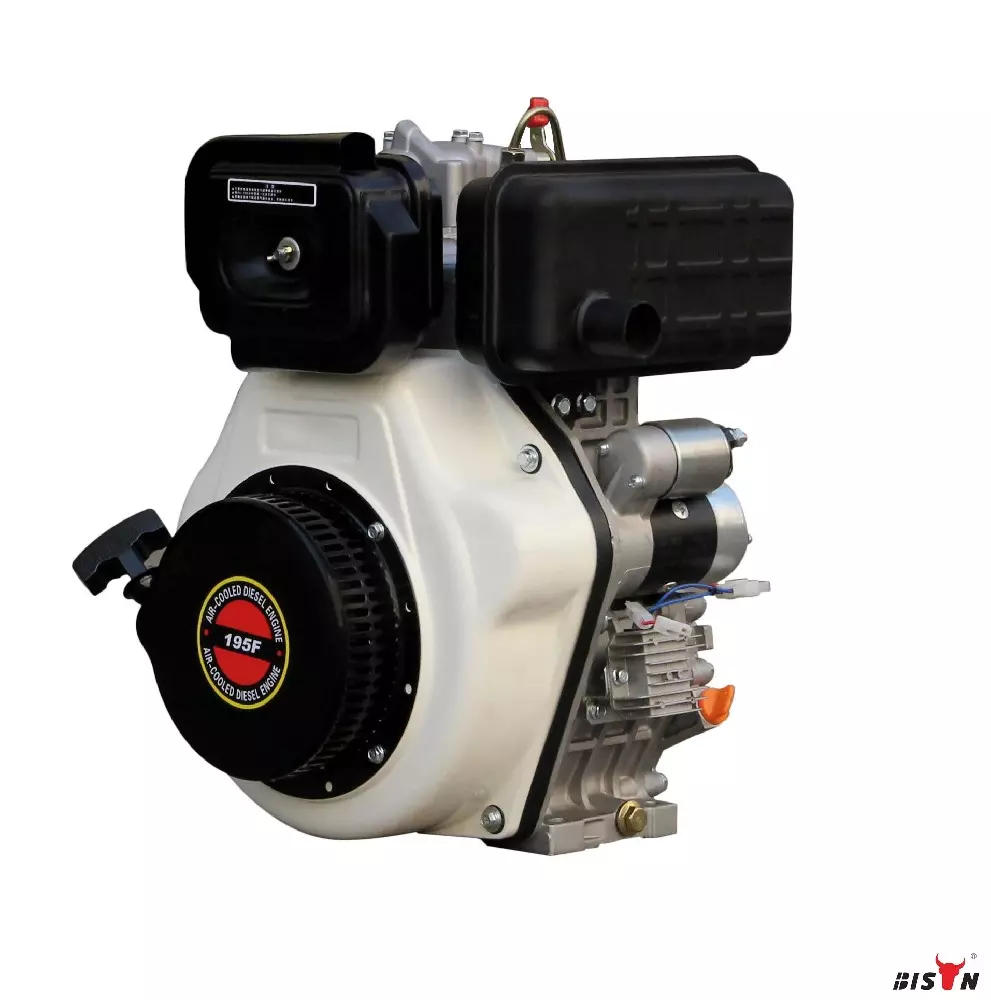
Engine (for non-electric pumps)
Pumps powered by gasoline or diesel engines are essential for remote locations, construction sites, agriculture, or emergencies.
Air-cooled engine: lightweight and easy to maintain, cooling itself through airflow. Ideal for portable and field applications.
Water-cooled engine: used in heavy-duty, continuous-operation pumps. Runs quieter, stays cooler, and lasts longer.
Structural support components
Stability and alignment are essential for long-term pump performance. Proper support reduces vibration, protects seals and bearings, and ensures smooth operation.
Pump base
The pump base keeps the assembly stable and absorbs vibrations, preventing misalignment that can cause noise, seal damage, or reduced efficiency.
Types of bases
Cast iron base: strong and heavy, ideal for large pumps requiring solid support.
Fabricated steel base: lightweight and versatile, suitable for small to medium pump installations.
Coupling
Couplings connect the motor shaft to the pump shaft, ensuring efficient power transmission while accommodating minor vibrations or misalignments.
Types of couplings
Rigid coupling: provides direct power transmission when alignment is precise.
Flexible coupling: absorbs shock loads and compensates for slight misalignment, protecting bearings and seals.
Sensors and safety components
Modern pumps often include electronic sensors and safety devices to prevent failure and improve performance. These components protect the pump, extend its life, and ensure safe operation.
Pressure sensors
Monitor pressure levels and shut down the pump if unsafe conditions occur.
Types of pressure sensors
Low-pressure switch: stops the pump when suction pressure drops, preventing dry-run damage.
High-pressure switch: prevents excessive discharge pressure that could burst pipes or damage fittings.
Thermal protection
Protects the motor from overheating.
Types of thermal protectors
Bimetallic protector: metal strips bend at high temperatures, cutting off power.
Electronic protector: more precise and widely used in modern pumps.
Float switch
Controls water levels in tanks and wells.
Types of float switches
Single float: turns the pump on/off based on water level.
Multi-float setup: used in industrial systems for precise level control.
How it all works together: a drop of water's journey
At BISON, we like to think of a water pump as a team working together to move water efficiently. Let's follow a single drop of water on its journey through the pump:
Motor starts: the motor or engine powers up, turning the pump shaft.
Shaft spins the impeller: the rotating shaft transfers energy to the impeller, the heart of the pump.
Impeller creates low pressure: as it spins, the impeller generates a low-pressure area that draws water in through the suction port.
Vanes propel water outward: the impeller vanes push water outward, converting motion into energy.
Casing converts velocity into pressure: water enters the casing, which guides the flow and transforms velocity into pressurized water.
Pressurized water exits: the water flows out through the discharge port, ready for taps, pipes, or irrigation systems.
Bearings and seals keep things smooth: bearings maintain shaft alignment and rotation, while seals prevent leaks, ensuring efficiency and reliability.
Through this teamwork of components, a single drop of water travels from suction to delivery — quietly, efficiently, and reliably every time.
How to evaluate water pump quality: a B2B buyer's checklist
When sourcing water pumps from manufacturers — especially for wholesale, distribution, or OEM purposes — the quality of individual components directly determines product reliability, after-sales costs, and end-user satisfaction. Here is what experienced buyers look for:
Impeller quality
Material: Ask whether the impeller is cast iron, stainless steel, aluminum, or plastic. For general-purpose pumps, cast iron provides the best balance of durability and cost. BISON uses precision-cast iron impellers across our gasoline and diesel water pump lines.
Balance: An unbalanced impeller causes vibration that destroys bearings and seals within months. Request information about dynamic balancing during manufacturing.
Surface finish: Smooth impeller surfaces reduce turbulence and improve hydraulic efficiency by 3–5%.
Mechanical seal specification
Check the seal face material combination. Carbon/ceramic is standard. Silicon carbide/silicon carbide is premium and lasts 2–3x longer in abrasive water.
Verify that O-rings are made of Viton or NBR (Nitrile), not generic rubber, especially for pumps handling chemically treated or hot water.
Bearing grade
Look for bearings from recognized manufacturers (e.g., NSK, SKF, or equivalent Chinese brands like HRB and ZWZ). Generic unmarked bearings are a red flag.
Sealed bearings (2RS type) are preferred for water pumps as they prevent moisture ingress.
Casing integrity
Request casing wall thickness specifications. Thinner walls save material cost but fail under pressure.
Check for porosity in cast aluminum or cast iron casings. Quality manufacturers (including BISON) perform pressure tests on every casing before assembly.
Engine / motor reliability
For engine-driven pumps, ask about the engine origin. BISON offers pumps with both our own branded engines and compatibility with Honda/Yamaha-type engine platforms.
For electric pumps, verify motor insulation class (Class B minimum, Class F preferred) and protection rating (IP44 minimum for outdoor use).
Conclusion
A water pump may seem simple from the outside, but inside, it is a carefully engineered system of components working together to move water efficiently. From the impeller and casing to bearings, seals, valves, strainers, sensors, and the power system, each part plays a vital role. Understanding these parts gives you a clear advantage, whether you are diagnosing a pump failure in the field, specifying components for a new project, or evaluating suppliers for your distribution business.
As a professional water pump manufacturer in China, BISON knows that a pump is more than just a machine — it's a precise combination of moving parts designed for efficiency and durability. A low-cost pump with a poorly balanced impeller, generic bearings, or substandard seals will cost far more in downtime and replacements than a well-built unit from a manufacturer who controls quality at every production stage.
Whether upgrading an existing system or selecting a new pump for industrial, agricultural, or domestic use, understanding how each component functions can make all the difference. Contact BISON today to explore our range of high-quality water pumps and benefit from expert support tailored to your application needs.

related blog
Acquire all kinds of knowledge from professional China factory
Pressure washer is surging/pulsing: An in-depth comprehensive guide
This comprehensive guide will help you understand pressure washer surging/pulsing, including the issue, its causes, how to diagnose it, and ultimately, how to fix it.
Generator runs for a few seconds then stop (How to fix?)
Is your generator runs for a few seconds and then stop? Don’t worry, we’ve got you covered. Read this post to know the reasons and also how to fix this problem.
generator low voltage output causes and solutions
So, what causes generator low voltage? How can you identify them? We'll cover all of these causes below to help you use a properly working generator.
related product
Quote high quality products from professional China factory