Front tine vs rear tine tillers
2025-09-15
Table of content
A tiller is an excellent tool for preparing gardens, fields, new ground, or flower beds. But as a beginner, which type should you choose? At the store, you'll often find two main options: front-tine tiller and rear-tine tiller.
Front-tine tillers have blades at the front and are lighter, making them easier to maneuver. Rear-tine tillers have blades at the back and offer more power, making them better for tough or larger areas.
In this article, BISON will explain the differences between the front tine and rear tine tillers and help you decide which is best for your needs.
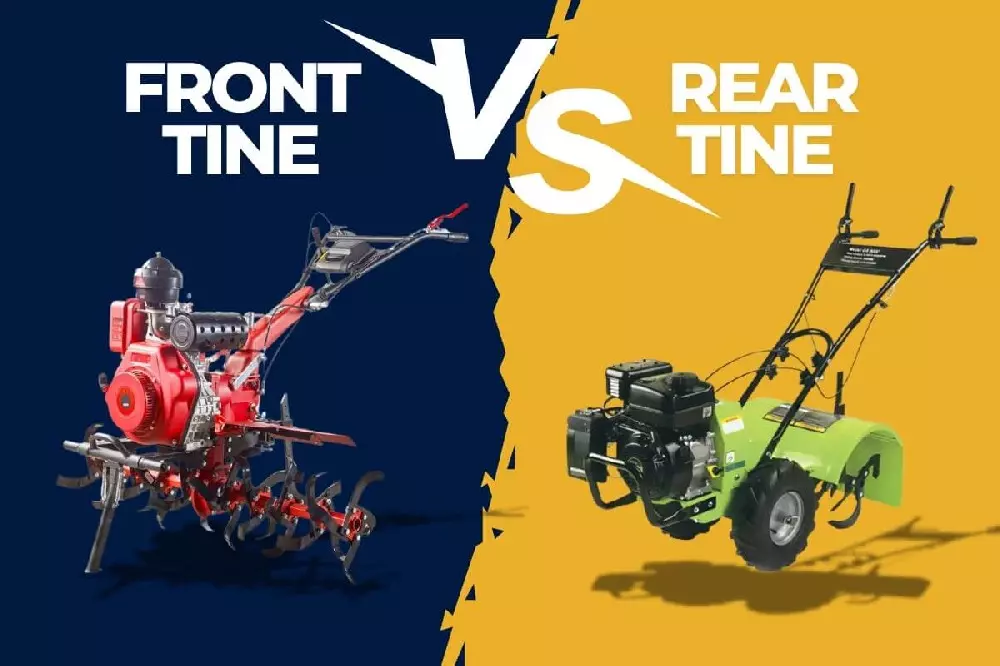
Front-tine tillers
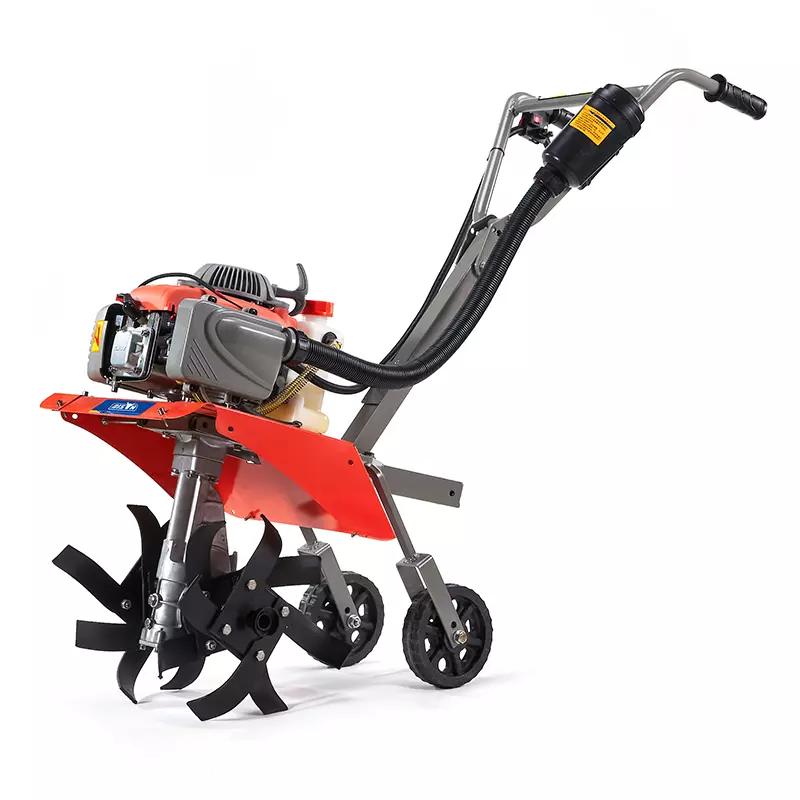
Front-tine tillers have blades, called tines, located at the front of the machine. As the tines spin, they dig into the soil and pull the tiller forward, making it easier to break up and prepare the ground. This design is especially useful in small spaces, garden beds, or around plants.
They're simple, affordable, and useful for soil preparation, compost mixing, and light weeding. Most models deliver a working width between 74 cm and 135 cm, and many accept additional tines to extend coverage.
Compared to rear-tine models, they are smaller, lighter, and easier to maneuver, which makes them more beginner-friendly. However, since the tines power the forward motion, you’ll need to maintain control and keep a firm grip to guide the machine properly.
Advantages:
Easy to steer and maneuver
Lightweight, requiring less effort
More affordable than rear-tine tillers
Supports a wide range of attachments (edging, moss raking, scarifying, ploughing)
Because of their maneuverability, front-tine tillers are best suited for small to medium gardens, lighter soils, and tight corners.
Disadvantages:
Harder to control in rough or compacted soil
Less powerful than rear-tine tillers
Not ideal for large areas or breaking new ground
Tine-driven propulsion can cause bouncing and skipping on rocky or heavily compacted surfaces
Rear-tine tillers
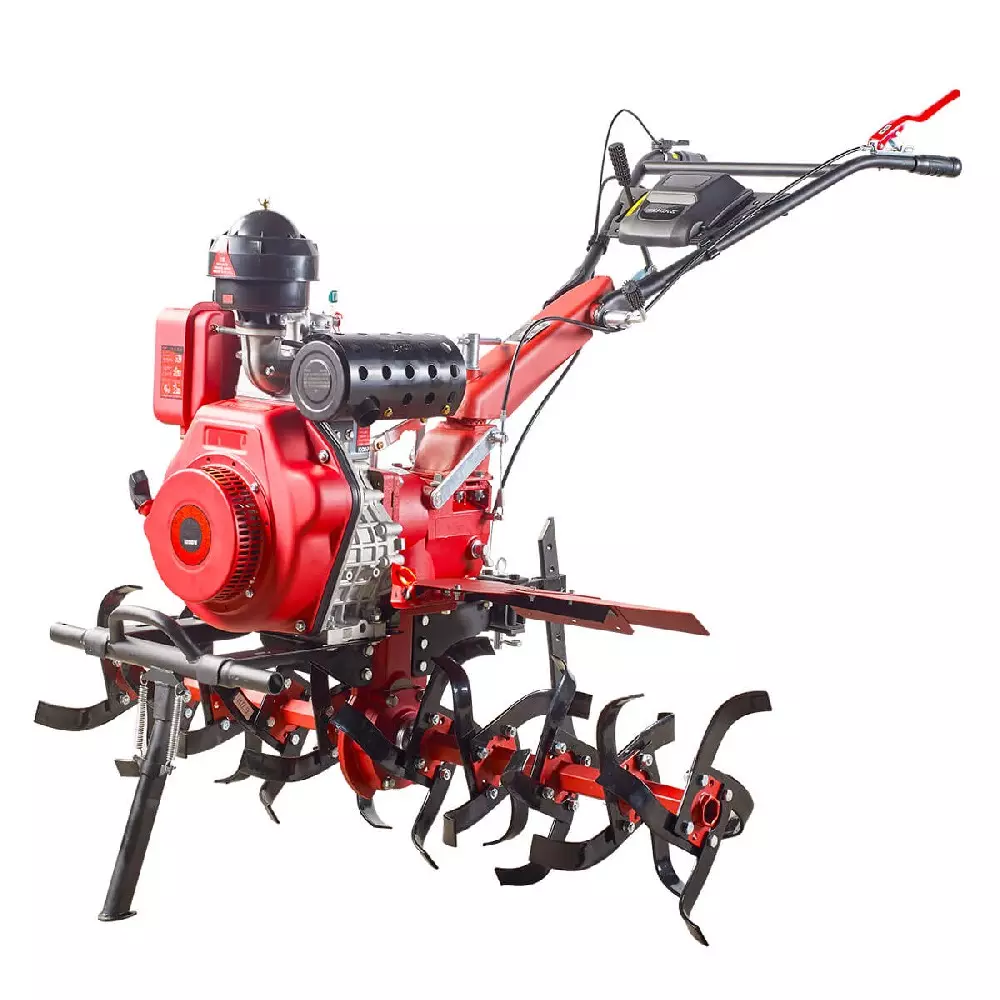
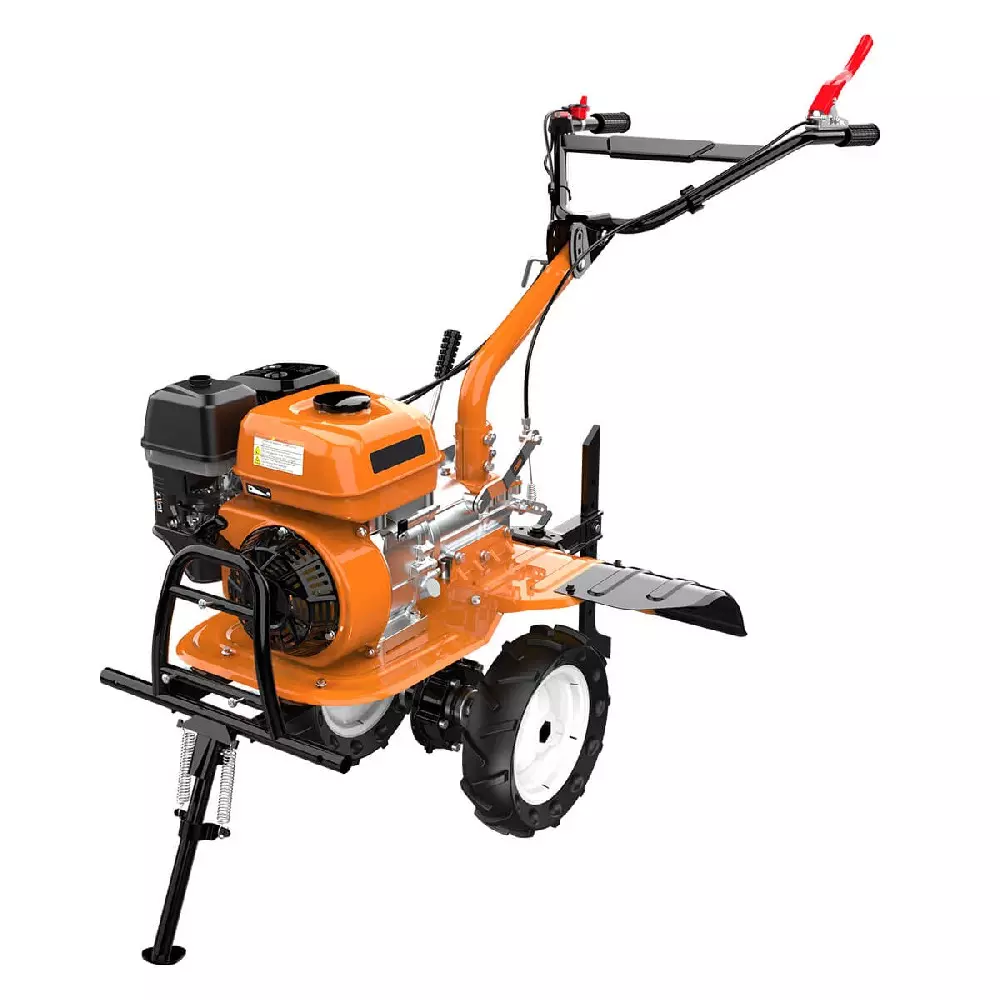
Rear-tine tillers have blades at the back while powered wheels push the machine forward. Tines can rotate in different directions, breaking soil more effectively and providing better control for heavy-duty work. This design is ideal for large areas, tough soil, or breaking new ground. Because of their power and stability, rear-tine tillers are often recommended for professional farmers and serious gardeners.
Many models feature counter-rotating tines (CRT), which spin opposite the wheels for deeper soil penetration—perfect for hard or unprepared ground. Some offer dual direction tines (DDT), allowing a two-pass workflow: run in CRT mode first to break virgin soil, then switch to standard rotation (SRT) mode to level and finish the seedbed. High-performing units also offer self-propelled operation with instant reverse for added handling control.
Advantages:
More powerful than front-tine tillers
Easier to control on slopes or uneven ground
Multiple gears for flexibility
Can handle attachments for extra gardening tasks
Models weighing over 500 lbs are less likely to skip and bounce in rocky or tough conditions, reducing operator fatigue and wear compared to lighter front or mid tine models
Disadvantages:
Heavier and harder to move around
More expensive than front-tine tillers
Not suitable for small gardens or work near delicate plants
Limited attachment versatility — rear-tine models cannot typically be fitted with accessories for moss raking, edging, scarifying, or ploughing, restricting their utility primarily to heavy soil preparation
What is the difference between a front and rear tine tiller?
| Feature | Front-tine tillers | Rear-tine tillers |
|---|---|---|
| Best for | Established gardens, small to medium plots (under 5,000 sq ft) | Breaking new ground, large plots (over 5,000 sq ft), clay or rocky soil |
| Tine placement | Front of the machine; pulls the tiller forward | Rear of the machine; shielded for safety |
| Propulsion | Tine-driven (requires manual guidance) | Wheel-driven (self-propelled) |
| Max tilling depth | Up to 8 inches (standard rotation) | Up to 10+ inches (counter or dual rotation) |
| Weight class | Lightweight and compact | Heavy-duty (CAN exceed 500 LBS for commercial units) |
| Attachment versatility | Supports edging, moss raking, scarifying, ploughing | Limited to heavy soil preparation |
| Price & maintenance | Affordable, low maintenance | Higher upfront cost, complex gear or hydraulic systems |
Position of tines
The most obvious difference is tine placement. On a front-tine tiller, the blades are located at the front of the machine with wheels at the back. On a rear-tine tiller, the blades are positioned at the rear and are shielded for safety, while the wheels drive the machine forward.
Engine power
Rear-tine tillers typically have larger engines designed for heavy-duty work, making them faster and more efficient on large plots or tough soil. Front-tine tillers have lighter engines that work well for smaller gardens and light soil preparation. The engine sits directly over the tines, helping push them into the ground for effective tilling. Clay and rocky soils demand more powerful engines and reinforced tines to break through compacted ground, while sandy or loamy soils can be worked effectively with standard lower-horsepower models.
Handling and maneuverability
Front-tine tillers are smaller, lighter, and easier to maneuver, which makes them suitable for tight spaces or rows between plants. They're also easier to store and transport. Rear-tine tillers, on the other hand, are bulkier and heavier, but this weight provides stability on slopes and uneven terrain, making them better for challenging ground.
Propulsion
Front-tine tillers use forward-rotating tines to pull the machine ahead, with small wheels mainly for balance. Rear-tine tillers are wheel-driven and can have tines that rotate forward, backward, or both (dual rotation). Higher-end models allow counter-rotating tines, which spin opposite the wheels for more efficient soil breaking—reverse rotation tines, exclusive to rear-tine models, turn opposite to wheel direction and can break up rocky soil, sod, and hard clay in fewer passes than forward rotation tines, making rotation type a primary selection criterion for compacted or unbroken ground. Powered wheels with larger tires give rear-tine tillers better traction and stability compared to front-tine units that rely on tine movement for propulsion.
Surface area
Rear-tine tillers are designed for large, open garden spaces where long, straight rows are needed. However, their bulk makes them less effective in tight corners or around obstacles. Front-tine tillers, being smaller and lighter, are much easier to guide around plants, fences, and narrow beds. Electric and battery-powered front-tine models are especially maneuverable, with battery versions avoiding the hassle of tangled cords.
Depth
Rear-tine tillers, with heavier engines and longer tines, can dig deeper into soil, making them ideal for breaking new ground or starting fresh garden beds. Front-tine tillers, using standard rotating tines (SRT), can reach up to 8 inches deep into topsoil, making them adequate for established garden seedbed preparation—but not recommended for breaking virgin ground, where a rear-tine tiller with counter-rotating tines (CRT) is the correct tool. Front-tine tillers are also better for shallow cultivation, loosening soil, and removing surface weeds in established beds without disturbing deep roots. Many tillers, regardless of type, allow adjustable tilling depth.
Coverage
Rear-tine tillers cover wide areas quickly thanks to their power and tilling width. Units in this class can weigh up to 500 pounds, dig up to 10 inches deep, and reach a 20-inch tilling width—specifications that directly disqualify lighter front-tine models for breaking new ground or tackling rocky, root-heavy soil in areas of 5,000–10,000 square feet. Front-tine tillers occupy a defined performance band: previously tilled soil in gardens up to 5,000 square feet. For smaller plots, front-tine tillers are well matched to gardens under 1,000 square feet, while mid-size gardens of 1,000–2,500 square feet benefit from models with adequate engine displacement and tilling width. Rear-tine tillers may feel oversized for small gardens and can struggle to fit between tight rows unless equipped with adjustable-width tines.
Maintenance
Both types should be cleaned and inspected after use, but rear-tine tillers typically require more maintenance due to their complex gear systems, larger engines, and additional features. For belt-driven units, check tension regularly: a properly adjusted belt should allow the manufacturer-specified amount of deflection. Squealing during operation indicates a loose belt requiring immediate inspection. Oil changes follow nine steps: (1) warm the engine briefly, (2) place a drain pan, (3) remove the drain plug, (4) drain fully, (5) replace the plug, (6) remove the old filter, (7) install a new filter, (8) refill to the marked level, and (9) run briefly and check for leaks. Tracking hours of use between services helps maintain consistent engine health across both tiller types.
Costs
Front-tine tillers are generally more affordable due to their smaller engines and simpler design. Rear-tine tillers are more expensive because of their power, features, and durability. Gas-powered models with higher horsepower tend to cost the most, regardless of type. Transmission type also affects upfront price, as hydraulic systems—which rely on hydraulic fluid to transfer power—generally cost more than gear-driven alternatives.
Applications
Rear-tine tillers, with their width and power, work quickly over large areas, dig deeper, and handle tough terrain like rocky or compacted soil. They are favored by professional gardeners, landscapers, small farms, and community gardens that need reliable, heavy-duty machines.
Front-tine tillers are more compact, affordable, and easier to store, transport, and maneuver. Their smaller size makes them ideal for home gardens, tight corners, and tasks like weeding between rows in established beds.
Rocky ground: Tillers cannot cut through solid rock, concrete, or cement, so large stones should be removed before use to avoid damage or flying debris. Rear-tine tillers manage rocky soil better thanks to their stability, while front-tine tillers may kick back when hitting hidden rocks.
Hard ground: Rear-tine tillers, with their stronger engines, are highly effective at breaking hard, compacted soil quickly. Front-tine tillers can also handle hard ground but require more time, effort, and repeated passes.
Making new beds: Rear-tine tillers are best for creating new garden beds, thanks to their deeper digging ability. Front-tine tillers can do the same job, but more slowly and at shallower depths.
Maintaining established beds: Front-tine tillers are excellent for maintaining existing beds by loosening soil, removing weeds, and mixing fertilizer between rows. Their narrow width and maneuverability make them more practical than rear-tine tillers for this purpose.
Soil preparation:Both types can mix compost, manure, or lime into the soil at shallow settings, creating nutrient-rich, aerated beds ready for planting.
Removing weeds: For large patches of weeds or thick grass, rear-tine tillers are effective at clearing the ground. However, for fresh weeds in narrow or established rows, a lighter and thinner front-tine tiller is more suitable.
Conclusion
The choice between a front-tine and rear-tine tiller depends on the size of your garden, the type of soil, and how comfortable you are with handling heavier machinery. Both types have unique advantages and limitations, so it’s important to match the tiller to your specific needs.
Garden size: small gardens benefit from a front-tine tiller, while larger plots are better managed with a rear-tine model.
Soil type: light or loose soil suits front-tine tillers; compact or rocky soil requires the power of a rear-tine tiller.
Frequency of use: occasional users may prefer a lighter machine, while frequent or professional gardeners need something more powerful.
User experience: front-tine tillers are easier for beginners, while rear-tine models are suited for experienced users.
Safety & features: look for shields, shut-off controls, adjustable depth, and counter-rotating tines to improve safety and versatility.
In short, front-tine tillers are ideal for small spaces and lighter tasks, while rear-tine tillers excel at heavy-duty work and large areas.
For reliable, high-quality tillers and excellent service, explore the BISON range today and find the perfect power tiller to make your gardening easier and more productive.

related blog
Acquire all kinds of knowledge from professional China factory
Front tine vs rear tine tillers
Compare front vs rear tine tillers for your garden: soil type, plot size, power, and digging depth. Find which tiller type best suits your needs.
how to replace tiller tines
Do you need to replace your tiller tines? BISON step-by-step guide shows you how to replace tiller tines safely and effectively
how to use a garden tiller?
In this guide, we’ll cover how to use a garden tiller effectively, from choosing the right type to operating it safely.
related product
Quote high quality products from professional China factory