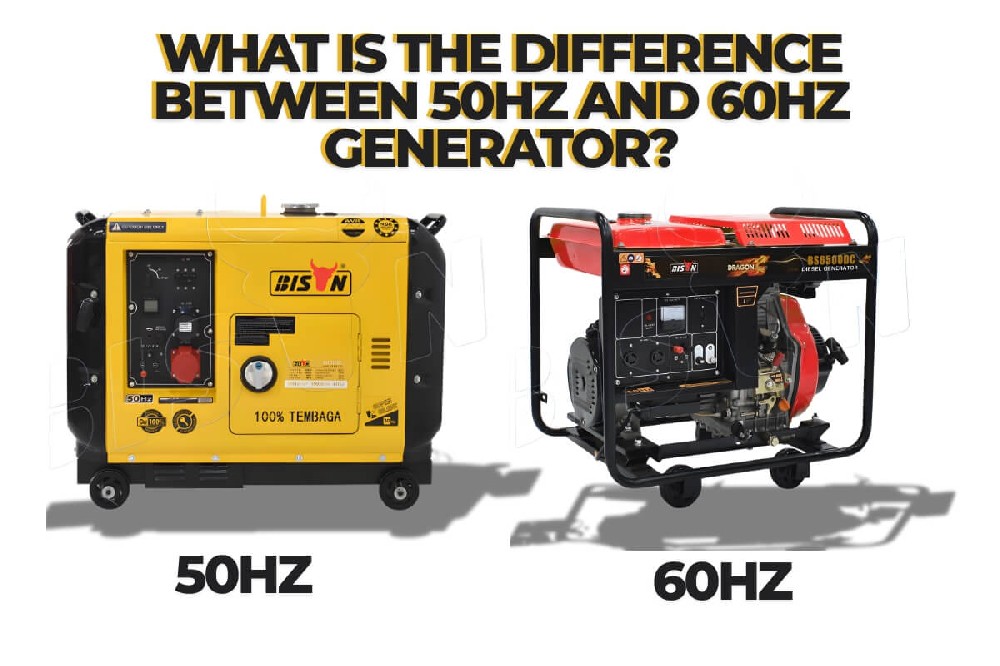
what is the difference between 50Hz and 60Hz generator
2026-03-12
Table of content
Nothing disrupts a day faster than turning on your generator and realizing your appliances are malfunctioning or flickering. This common problem often occurs when the generator frequency doesn’t match the devices you’re powering. Generator frequency, measured in Hertz (Hz), represents the number of alternating current (AC) cycles per second and directly affects performance, compatibility, and the safety of electrical equipment.
Different countries use different electrical frequencies, mainly 50Hz or 60Hz.
As a professional generator manufacturer, BISON understands the importance of choosing the right frequency. In this article, we explain the differences between 50Hz and 60Hz generators, how frequency affects engine speed, generator size, and applications, and why understanding these differences is important when selecting the right generator for your home, business, or industrial needs.
What does frequency (hz) mean?
In electrical systems, frequency refers to the number of alternating current (ac) cycles that occur per second, measured in hertz (hz). It describes how often the electrical current changes direction each second.
The frequency of electrical power is not just a technical specification — it also has a historical background shaped by the early development of electrical systems. In the late 19th and early 20th centuries, as electricity became widely adopted, different regions experimented with various frequencies and voltages to improve efficiency, equipment performance, and power transmission. Over time, two main standards became widely used: 50hz and 60hz.
Today, 50hz power is the standard in most of europe, asia, africa, and australia, while 60hz power is commonly used in north america and parts of south america. In some cases, isolated sections of power grids may still operate at different frequencies.
Frequency standards are also often paired with typical voltage levels. In many 50hz regions, household and commercial electricity usually operates at 220–240v, while in 60hz regions it commonly operates at 110–120v.
| Region | Frequency (HZ) | Typical voltage (V) | Technical access requirements |
| Europe | 50hz | 230/ 400 | Must comply with iec 60034 standard; CE certification is A mandatory requirement. |
| North america (US & canada) | 60hz | 120 / 240 / 480 | Emphasis on nema standards; UL or CSA safety certification is required. |
| Latin america | 60hz (multiple) | 120 / 220/ 380 | In countries like brazil, 50hz/60hz coexist, requiring dual-band support. |
| Middle east and africa | 50hz | 220 /400 | Severe power grid fluctuations require generators with extremely strong frequency transient response capabilities. |
| Japan | 50hz/60hz | 100 /200 | The unique east-west split power grid necessitates the use of frequency converters for equipment exported to this region. |
Frequency in generators
For generators, frequency refers to how many times the current changes direction each second. Generators produce ac power through the mechanical rotation of the engine and rotor inside a magnetic field. This rotation induces alternating voltage in the coils, creating the ac cycles that determine the generator's frequency.
The speed of the engine directly affects the frequency — faster rotation produces a higher frequency, while slower rotation produces a lower frequency. For example, a 50hz generator produces 50 ac cycles per second, while a 60hz generator produces 60 cycles per second.
Impact on connected equipment
At BISON, we emphasize that generator frequency directly affects the performance and safety of the equipment it powers. Understanding how different electrical devices respond to frequency helps prevent damage and ensures reliable operation.
AC motors
AC motors are highly sensitive to frequency because motor speed is directly related to the supply frequency. A motor designed for 60Hz will run slower on 50Hz power. Operating a motor at the wrong frequency can reduce performance and may cause overheating, excessive vibration, or mechanical damage, especially in equipment such as pumps, compressors, and industrial machinery.
Transformers
Transformers rely on the correct frequency for efficient operation. Using a 60Hz transformer on 50Hz power can cause the magnetic core to saturate, generating excessive heat and potentially damaging insulation. Operating a 50Hz transformer on 60Hz power may reduce efficiency and limit its full capacity.
Resistive loads
Resistive devices such as heaters and incandescent bulbs are generally not affected by frequency differences because they mainly depend on voltage. These loads usually operate normally on either 50Hz or 60Hz power.
Electronics
Most modern electronics, including computers, TVs, and chargers, are designed to support both 50Hz and 60Hz power. However, it is still important to check the device label before connecting it to a generator.
Key differences between 50Hz and 60Hz generators
When selecting a generator, understanding the differences between 50Hz and 60Hz models is important because frequency affects engine speed, equipment compatibility, and overall performance.
Engine speed (RPM)
Generator frequency is directly related to engine speed, expressed by the formula:
Frequency (Hz) = (Number of Poles × RPM) ÷ 120
For the same number of poles, a 60Hz generator must run at a higher RPM than a 50Hz generator. Higher engine speed can produce slightly more noise and wear, while 50Hz generators operate at lower RPMs, which may reduce noise and mechanical stress.
| Mechanical parameters | 50hz (1500 RPM) | 60hz (1800 RPM) | Technical impact analysis |
| Centrifugal stress | Basic design basis | Increases by approximately 44% | Requires higher levels of rotor balancing accuracy and fastener strength. |
| Average piston linear velocity | Typical value 8.5 m/s | Typical value 10.2 m/s | Increased frictional heat generation between cylinder liner and piston rings, shortening overhaul interval (tbo). |
| Bearing lubrication frequency | Standard maintenance cycle | Demand increased by 20% | High speed leads to increased shear force in the lubricating oil and higher oil temperature. |
| Vibration harmonic frequency | 25 HZ basic vibration | 30 HZ basic vibration | Specifically designed vibration-damping feet are required to avoid resonance with the building structure. |
BISON's 60Hz dedicated series generators underwent enhanced fatigue testing during the design phase. By employing high-strength crankshaft alloys and reinforced cooling circulation pumps, they effectively offset the additional heat load brought about by high speeds, ensuring that they have the same service life as the 50Hz models in the high-intensity operating environments of North America and some Asian markets.
Power output and efficiency
Because they rotate faster, 60Hz generators can often produce slightly more power from the same engine size. In contrast, 50Hz generators may operate more efficiently under steady loads in industrial or heavy-duty applications.
Equipment compatibility
Most appliances and industrial equipment are designed for a specific frequency. Using the wrong frequency can cause motors to overheat, timers to run incorrectly, or electronic devices to malfunction.
Size and weight
Since 60Hz generators operate at higher speeds, they can achieve similar power output with smaller and lighter components. In comparison, 50Hz generators may require larger parts to produce the same output at lower speeds.
Heat and wear
Lower-speed 50Hz generators generally produce less heat and experience smoother operation. Higher-speed 60Hz generators may experience more heat and wear but can deliver strong performance in high-demand applications when properly maintained.
Understanding these differences helps users choose a generator that meets their power needs while ensuring safe and reliable operation.
How to choose the right generator frequency
Selecting the correct generator frequency is essential for safe and reliable operation. Bison recommends considering three key factors when choosing the right generator.
1. Location
First, match the generator frequency with your region's power standard. In 50hz regions such as Europe, Asia, Africa, and Australia, a 50hz generator ensures compatibility with local appliances and equipment. In 60hz regions like North America and parts of South America, a 60hz generator is required. Using the wrong frequency may reduce performance or damage equipment.
2. Type of equipment
Some devices are sensitive to frequency, including AC motors, pumps, transformers, and industrial machinery. Operating them at the wrong frequency can cause overheating, inefficiency, or mechanical damage. Resistive loads such as heaters and incandescent bulbs are less affected, and many modern electronics support both 50hz and 60hz. However, checking the device label is always recommended.
3. Application
Generator frequency also determines where the generator can be used effectively.
Homes and residential use
50Hz generators are commonly used in regions such as Europe, Asia, Africa, and Australia, where household appliances operate at 220–240v and 50hz.
60hz generators are typically used in North America and parts of South America, where appliances operate at 110–120v and 60hz.
Industrial machinery
Industrial equipment such as motors, pumps, and compressors must operate at the correct frequency to maintain performance and prevent overheating. Factories use generators that match their regional frequency standard.
Data centers and their equipment
Data centers require stable frequency and voltage to protect servers and networking equipment. Backup generators must match the local grid frequency to ensure reliable operation.
Construction sites
Portable generators used for construction tools, lighting, and temporary power must match the frequency of the equipment being used.
International trade and equipment transport
When exporting or importing equipment, frequency compatibility is important. Using a generator that matches the local power standard helps ensure machinery and appliances operate correctly.
Can you use a generator outside its frequency region?
Choosing the correct generator frequency is important, especially when operating in a region with a different electrical standard. Bison recommends understanding the potential risks and available solutions before using a generator outside its designated frequency region, as equipment safety and performance depend on proper frequency matching.
Safe vs. unsafe scenarios
Safe
Some modern electronic devices such as laptops, LED lights, and chargers support dual-frequency operation (50–60hz). These appliances can usually work properly even if the generator frequency does not match the regional standard.
Unsafe
Frequency-sensitive equipment such as AC motors, pumps, industrial machinery, and transformers can be damaged if operated at the wrong frequency. Motors may run too slowly or too fast and overheat, while transformers may experience core saturation and excessive heat.
Possible solutions
Adjusting the engine governor
Some generators allow engine speed adjustments to match the required frequency. For example, a 2-pole generator produces 60hz at about 3,600 rpm and 50hz at about 3,000 rpm. A 4-pole generator produces 60hz at around 1,800 rpm and 50hz at about 1,500 rpm. However, not all generators support this adjustment.
Using frequency converters
Frequency converters can change ac power from one frequency to another using an ac-dc-ac conversion process. They provide a stable voltage and frequency with a pure sine wave output, allowing equipment designed for a different region to operate safely. Frequency converters can also offer additional benefits such as improved power regulation, motor protection, better speed control, and programmable output functions.
Conclusion
Understanding the difference between 50Hz and 60Hz generators is essential for safe and reliable power supply. The main difference lies in engine speed (RPM), which affects generator performance, noise, durability, and compatibility with electrical equipment. 50Hz generators operate at lower RPMs, offering quieter operation and reduced mechanical stress, while 60Hz generators run at higher speeds and can deliver slightly more power in a smaller and lighter design.
The key takeaway is to always match your generator’s frequency with the regional standard and the requirements of the equipment being powered. This helps prevent equipment damage and ensures efficient and stable operation.
As a professional generator manufacturer, BISON provides reliable generator solutions for both 50Hz and 60Hz applications. Explore our generator models to find the right option for your home, industrial, or international power needs.

related blog
Acquire all kinds of knowledge from professional China factory
Generator runs for a few seconds then stop (How to fix?)
Is your generator runs for a few seconds and then stop? Don’t worry, we’ve got you covered. Read this post to know the reasons and also how to fix this problem.
generator low voltage output causes and solutions
So, what causes generator low voltage? How can you identify them? We'll cover all of these causes below to help you use a properly working generator.
charging electric vehicles with generators: A comprehensive guide
BISON will delve into the feasibility of using a generator to charge an electric vehicle, discussing the advantages and disadvantages. We will also consider...
related product
Quote high quality products from professional China factory